
Guide
How to play Pong
Where to buy


Released in 1972, Pong, a groundbreaking arcade video game, recreates table tennis with a premise that is extremely simple but innovative for its time. Set on a virtual court where two paddles face each other and try to bounce a ball back and forth, it laid the foundation for the video game industry by becoming one of the first commercial hits in the field. What sets it apart is its radical minimalism: no complex plots or detailed graphics, just pure gameplay and head-to-head competition between two players, setting a precedent that would influence game design for decades.
Pong's style of play is pure arcade, built on reflexes and coordination. A typical match has two players each controlling a vertical paddle at opposite ends of the screen, trying to send the ball past the other side while keeping it from crossing their own baseline. The core mechanics are surprisingly simple: move the paddle up or down to intercept the ball, which bounces off the top and bottom edges of the screen and off the paddle itself. The game has no set ending, and you play until one player reaches an agreed score.
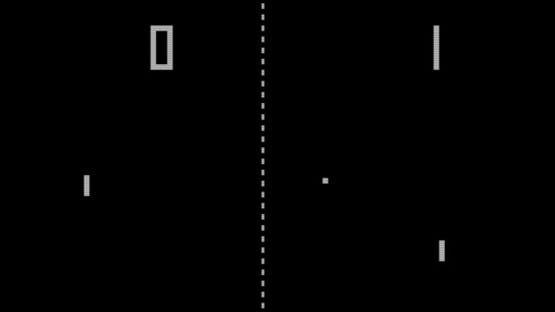
When you start playing Pong, the most important thing is to get used to the speed of the game and how responsive the controls are. In your first few hours, it helps to practice against the computer or a second player to understand how the ball speeds up with every bounce and how bounce angles change its path. Short sessions are a good way to build a basic feel for when and where to move the paddle, without worrying about winning yet, just learning the simple physics of the game.
To make progress in Pong, you need to understand that the game has no complex systems like levels or power-ups. The only real variable is your own precision. The key is to anticipate the ball's path and react with the speed and accuracy it demands. Over time, players develop movement patterns that let them cover more of the screen and anticipate the opponent's moves, whether the opponent is human or AI-controlled.

The most common beginner mistakes include moving the paddle constantly instead of waiting for the right moment to intercept the ball, and underestimating how each bounce changes the ball's speed and direction. Another frequent mistake is focusing only on the ball without keeping a balanced position on the screen, which leaves gaps you can't cover. To avoid these problems, move only when you need to and hold a central position that lets you cover most of the area quickly.
Specifically, to get better at Pong, practice short, precise movements instead of big sweeps, and watch how the ball interacts with the edges. It helps to try not just to return the ball, but to do it at angles that make your opponent's reply harder. Over time, you develop a kind of "game sense" that lets you anticipate moves and react almost by instinct.

If you appreciate the simplicity and purity of mechanical games, with no need for storylines or elaborate graphics, you'll find a classic in Pong. It's also a great fit if you want a retro experience or want to understand the fundamentals of video games. Its accessibility and competitive nature appeal to casual players and to anyone who enjoys challenges based on pure skill, with no random elements or complex progression systems.
Pong came out on 29 de noviembre de 1972. Platforms, genres and ratings are on the Pong game page.
Related games


Last updated: 24 de noviembre de 2026.
Powered by PairProgramming · custom software development, AI and automation.