
Guide
How to play Surviving Mars
Where to buy


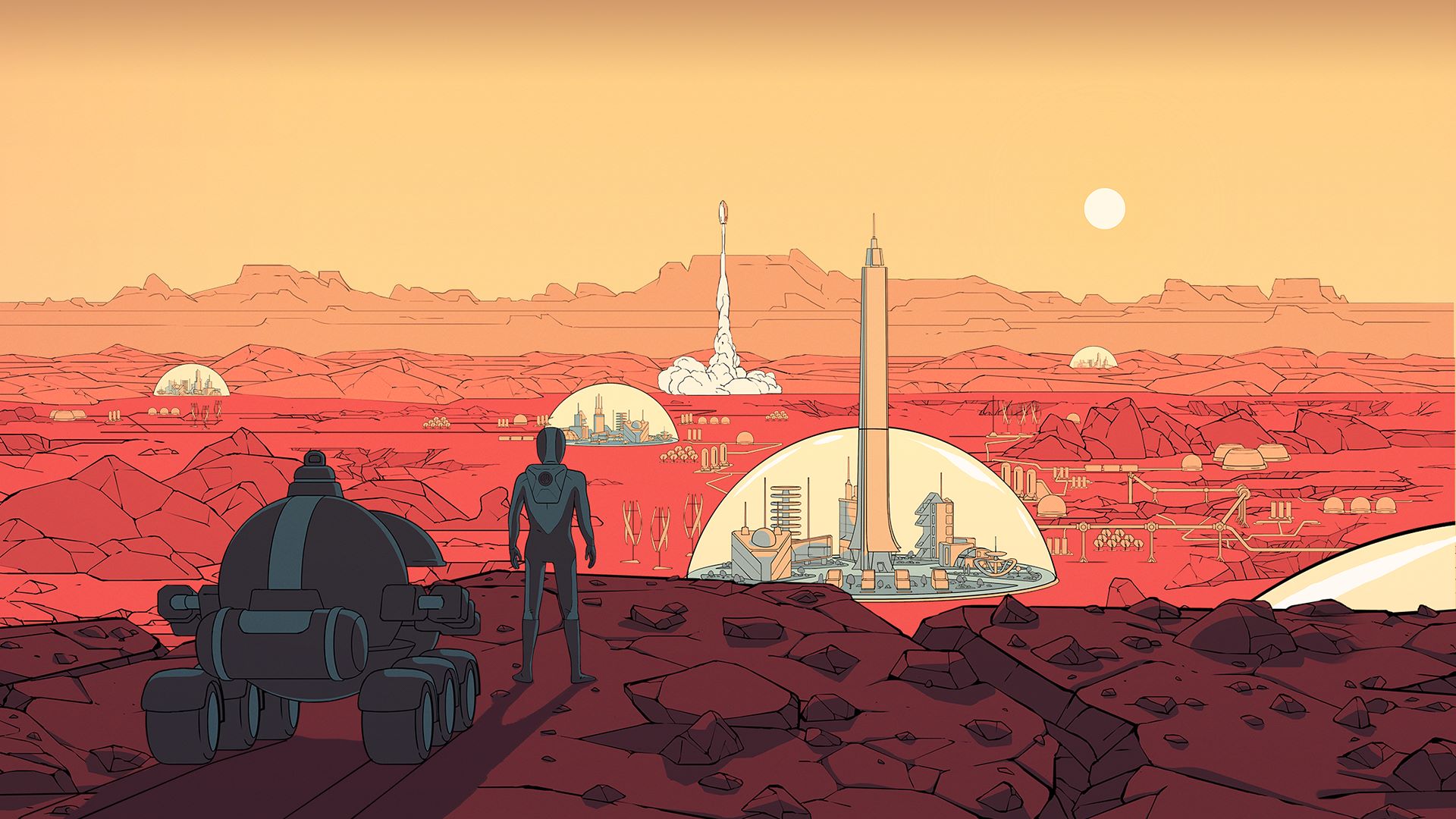
Released in 2018, Surviving Mars is a simulation and strategy game that puts you in charge of founding and running a human colony on the Red Planet. The setting blends a realistic view of space science with a touch of futurism, presenting a desolate landscape of reddish rocks, dust storms and an almost hostile atmosphere. What sets it apart from other building games is that every decision has to respect Mars's physical limits: the scarcity of oxygen, the need to extract water from underground, the reliance on solar and wind power, and the complex logistics of keeping colonists alive and productive under extreme conditions.
The gameplay revolves around resource management and medium- and long-term planning. A typical game begins with the arrival of a cargo ship carrying the initial modules, and you have to deploy structures, connect networks and assign colonists to specific tasks. The core mechanics revolve around producing and consuming the four basic resources, power, water, oxygen and food, building domes that provide habitable environments, and using drones to automate the extraction and transport of materials. Research advances as projects are completed, unlocking new buildings and upgrades that make the colony easier to expand.

In the first hour, the most sensible goal is to set up a minimal self-sufficient base. First, place a power source, such as solar panels or wind turbines, and make sure they are connected to a power grid that covers the essential modules. Next, build a Water Extractor on an underground water deposit, or a Moisture Vaporator, and link them to a pipe system that carries water to the domes. Then install MOXIE units, which run on power and produce the oxygen the colony breathes. Finally, erect a residential dome with enough capacity for the first colonists. Don't forget to assign drones to move resources between these facilities, and place a few research labs to start unlocking basic technologies.
To progress steadily, you need to understand several key systems. The resource cycle of power, water, oxygen and food is interconnected, so a shortage in one quickly affects the others, which makes planning production and storage essential. Drones act as the logistics backbone: their number, speed and carrying capacity determine how efficiently materials move between mines, factories and domes. The power and pipe networks should be designed with redundancy to avoid outages when a unit fails or stops working. Finally, technologies are unlocked with research points generated by labs, and prioritizing technologies that boost resource output or drone efficiency speeds up expansion.
Beginners often make mistakes that can cripple the colony. One of the most common is expanding too fast without a stable base of power and water, which leads to blackouts and oxygen shortages. Another frequent mistake is underestimating how many drones you need: without enough of them or optimized routes, resources get stuck and colonists start to suffer. It's also easy to forget dust storms, which stop MOXIEs and Moisture Vaporators, so it pays to keep reserves of oxygen and water. Finally, many players ignore early research, which delays access to more advanced buildings.
To expand more effectively, start with well-defined "production chains": each resource should have its own chain that includes extraction, processing and distribution. Make use of prefab buildings shipped from Earth, since they can be deployed right away. Always keep enough power in reserve to cover consumption peaks, adding batteries or backup generators before the Martian night causes a drop. Spread your drones across several Drone Hubs, since each drone only works within range of its controller, and that way you avoid bottlenecks. In research, focus first on technologies that improve energy efficiency and water extraction capacity, since they are the pillars of any viable colony. As the population grows, build more domes and expand food infrastructure, but always check that resource output can sustain the new demand before expanding.

Surviving Mars is built for players who enjoy meticulous planning and managing complex systems. If you're drawn to science fiction, space colonization and the challenge of optimizing resources, you'll find the game especially rewarding. It also suits players who prefer no real-time pressure, since most decisions can be made at your own pace and the game moves at its own rhythm. If you like city builders and management sims and have the patience to solve logistical puzzles, this title offers a deep and satisfying experience.
Surviving Mars came out on 14 de marzo de 2018. Platforms, genres and ratings are on the Surviving Mars game page.
Related games


Last updated: 5 de noviembre de 2026.
Powered by PairProgramming · custom software development, AI and automation.