Guide
How to play The Oregon Trail
A simulation and adventure game set in 1848, The Oregon Trail lets you play the leader of a wagon train of settlers. Your goal is to guide a group of people from Independence, Missouri, to the Willamette Valley in Oregon, following the famous Oregon Trail. What sets this game apart is its educational focus, which aims to teach the harsh realities of pioneer life in the 19th century by combining strategic planning with decision making under pressure. Unlike many games of its era, The Oregon Trail is not about fast action. It is about managing resources and making choices that will decide whether your party survives.
The game plays out in a single session that simulates a trip lasting several months, divided into stages that represent different stretches of the trail. Each stage presents situations where you have to decide on your pace, how to use your supplies, and how to respond to random events. The core mechanics revolve around managing resources like food, water and health, as well as planning your route. The turn system lets you travel at different speeds, each with its own risks: moving fast uses up more resources but gets you to your destination sooner, while going slow saves provisions but lengthens the trip and raises the odds of running into dangers.
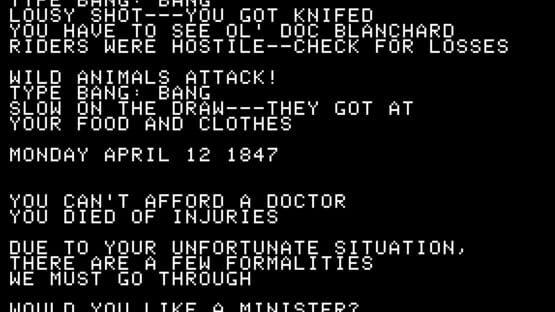
When you start the game, the first thing to do is choose your profession, which affects your starting points and skills. Then you need to outfit your wagon with the right supplies: food, medical tools and spare parts for the wagon. During your first hour of play, it is essential to balance your starting resources without overspending in any one area, since the trip will be long and unpredictable. You should get familiar with the hunting system, which lets you get extra food but costs time and resources. It is also important to learn to read the game's messages and recognize when you need to stop to rest or repair the wagon.
To make progress in The Oregon Trail, you need to understand several key systems. Resource management matters most, since running short of food or water can lead to hunger or dehydration. Your party's health is another crucial system, because illness and accidents can reduce the number of people in your group. How you handle random events, such as river crossings or encounters with Native Americans, will also shape your success. Finally, route planning lets you choose between risky shortcuts and safer but longer paths.
Beginners often make mistakes like overestimating their supplies and carrying too much weight, which slows the wagon train, or underestimating the dangers of the trip by moving too fast and burning through resources. Another common mistake is ignoring the party's health by skimping on rest or on treating illness. To avoid these problems, it is a good idea to make conservative choices early in the trip, stockpile resources, and keep a moderate pace that leaves room to react to surprises.
Specific tips for getting further include always carrying a surplus of food as a safety cushion, prioritizing rest when someone in the party falls ill, and using hunting strategically when supplies start to run low. It also helps to write down your decisions and their results so you can learn from your mistakes in future runs. Remember that the game has random elements, so even with the best strategy, surprises can still come up.
People who enjoy decision-based simulations, resource management and learning about history are the main audience for The Oregon Trail. If you like games where long-term planning and strategic decisions matter more than fast action, this title will give you plenty to think about. If you want an educational experience that mixes entertainment with historical learning about westward expansion in the United States, you will find that balance here.
The Oregon Trail came out on 3 de diciembre de 1971. Platforms, genres and ratings are on the The Oregon Trail game page.
Related games






Last updated: 22 de noviembre de 2026.
Powered by PairProgramming · custom software development, AI and automation.