Guide
How to play Universe Sandbox
Where to buy


PC requirements
Can your PC run Universe Sandbox?
- Minimum RAM:
- 4 GB
- Minimum graphics:
- 4 GB Video Memory†
- Minimum storage:
- 4 GB
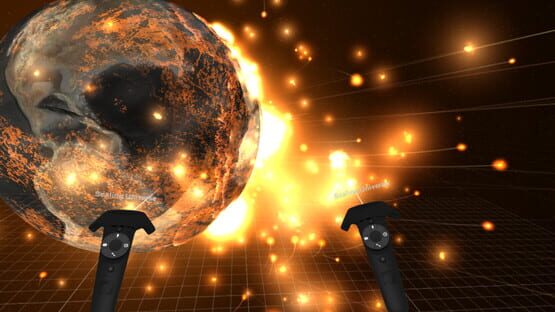
On an immense scale, Universe Sandbox is an indie space simulator released in 2008 that lets you create, destroy and manipulate celestial objects. Unlike other space games, it has no linear plot and no traditional objectives. It focuses on pure sandbox play, where real physics governs every interaction. Its premise is simple but powerful: it gives players control over planets, stars, asteroids and other celestial bodies, letting them watch how gravity, collisions and climates interact in real time. What truly sets it apart is its focus on scientific simulation, combining educational elements with the ability to build spectacular or destructive cosmic scenarios.
The gameplay in Universe Sandbox is completely open, with no missions or predefined structure. A typical session starts with a basic solar system or an existing one, where players can add, modify or remove celestial objects. The core mechanics revolve around simulating gravity, collisions between bodies, climate effects and material interactions. For example, if you bring two planets together too fast, a realistic collision occurs that can destroy both or create a new body. Players can adjust masses, velocities and distances, watch how those changes affect orbits and stability, or even detonate stars to see the consequences on a cosmic scale.
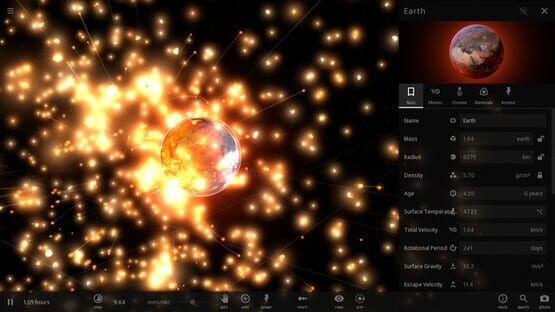
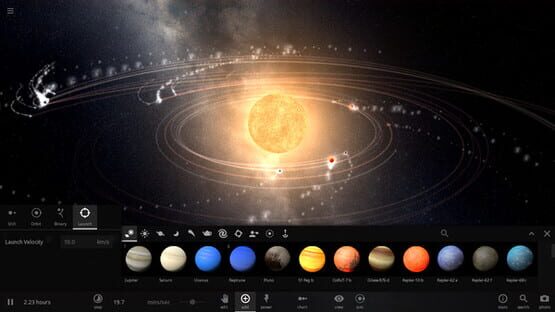
When you start, the best approach is to explore the interface without fear of making mistakes. A good first hour can go to getting familiar with the basic controls: how to add planets, change their properties and watch their effects. Try building a simple solar system with a central star and a few planets in orbit, then experiment by changing masses and distances. Also try the premade simulations the game offers, such as asteroid collisions or a comet hitting Earth, to understand how the different elements interact. Don't worry about "getting it wrong". Part of the game's charm is finding out what happens when things go badly.
To make progress in Universe Sandbox, it's essential to understand several key systems. The first is gravity, which affects every interaction between objects. Understanding how masses and distances influence orbits will let you build stable or chaotic systems, depending on your goal. Another important system is heat transfer between bodies, which explains why planets close to a star are hotter. You also need to understand how collisions affect the mass and trajectory of objects, and how interactions between atmospheres and surfaces create varied climates.
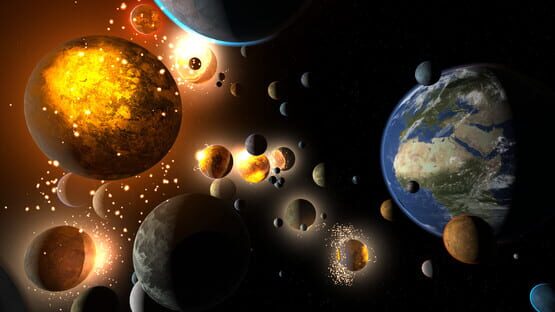
Common beginner mistakes include overloading the system with too many objects, which can cause slowdowns or crashes. Another mistake is underestimating scale: cosmic distances are enormous, and placing objects too close together can lead to immediate collisions. It's also common to overlook orbital inertia, which leads to planets suddenly flying off or collapsing. To avoid these problems, start with simple systems and adjust the scale as needed. Use the pause and slow motion tools to get better control over your simulations.
Concrete tips for moving forward include experimenting with extreme scenarios, such as creating massive stars that collapse into black holes or trying different planetary compositions to see how they affect the atmosphere. Use the visualization tools to better understand the forces at play, such as gravitational fields and orbit lines. Also, record your most interesting simulations so you can share them or review them later, since some interactions can be hard to catch in real time.
Universe Sandbox brings together exploration, experimentation and unrestricted creativity, and it's made for players who enjoy that kind of game. It especially appeals to those with scientific curiosity who are interested in astronomy, physics or simulation. It doesn't require combat skills or complex strategy, just patience and a curious mind. If you like finding out for yourself how the universe works, or if you enjoy the satisfaction of creating stable and chaotic systems alike, this game will be an interesting and educational experience.
Universe Sandbox came out on 1 de mayo de 2008. Platforms, genres and ratings are on the Universe Sandbox game page.
Related games




Last updated: 22 de noviembre de 2026.
Powered by PairProgramming · custom software development, AI and automation.